Introduction
Air quality has become a mainstream household concern. Whether you are dealing with allergies, wildfire smoke, pet dander, or general indoor air quality, an air purifier can help. But with hundreds of models on the market, choosing the right one can be overwhelming.
This guide explains how air purifiers work, what features actually matter, and how to choose the right unit for your specific needs and budget. We focus on publicly available information from manufacturer specifications, industry standards, and aggregated user feedback.
Important note: We do not conduct independent laboratory testing. Our recommendations are based on manufacturer specifications, industry certifications (such as AHAM verification), professional reviews from trusted publications, and aggregated user feedback from multiple platforms.
---
Understanding Air Purifier Technology
How They Work
Air purifiers draw indoor air through one or more filtration stages, each targeting specific types of contaminants:
1.
Intake -- A fan pulls air into the device
2.
Pre-filtration -- A washable mesh captures large particles (dust, hair), protecting downstream filters
3.
Primary filtration -- HEPA media, activated carbon, or electronic capture removes the bulk of pollutants
4.
Secondary treatment (optional) -- UV-C germicidal lamps or photocatalytic oxidation may be used to address microorganisms and VOCs
5.
Exhaust -- Cleaned air is returned to the room
Key Technologies
| Technology | How It Works | Best For | Limitations |
|------------|-------------|----------|-------------|
|
HEPA | Dense fibrous mat captures particles via mechanical interception | Allergens, dust, smoke particles | Does not address gases or odors alone |
|
Activated Carbon | Porous carbon adsorbs gas molecules | VOCs, odors, chemicals | Limited effectiveness for particles |
|
Ionizers / ESP | High voltage charges particles, which settle on surfaces | Fine particles | May produce trace ozone; requires plate cleaning |
|
UV-C | UV-C light disrupts DNA/RNA of microorganisms | Bacteria, viruses | Not effective for particles or gases alone |
|
PCO (Photocatalytic Oxidation) | UV light activates a catalyst that oxidizes VOCs | VOCs, mold spores | Slow process; usually paired with mechanical filtration |
What the Specs Actually Mean
| Spec | Definition | Why It Matters |
|------|------------|----------------|
|
CADR (Clean Air Delivery Rate) | Volume of filtered air (ft³/min) for smoke, dust, pollen. Higher = faster cleaning. | Compare CADR to room size. AHAM-verified CADR numbers are more reliable than manufacturer claims. |
|
ACH (Air Changes per Hour) | How many times the purifier can theoretically clean the total room air in one hour. | Higher ACH means faster air cleaning. Calculate: ACH = (CADR × 60) ÷ Room Volume (ft³). |
|
Filter MERV Rating | Minimum Efficiency Reporting Value (1-16). Higher = finer particle capture. | MERV 13-16 aligns with HEPA-level performance for particles >0.3µm. |
|
Room Size | Manufacturer's recommended maximum room size. | Real-world performance may be lower than rated, especially in open floor plans. |
|
Noise (dB(A)) | Sound level at each fan speed. | Important for bedrooms and offices. Lower is better for quiet environments. |
|
Filter Life | Estimated runtime before replacement needed. | Affects long-term cost. Actual life depends on air quality and usage. |
Common Marketing Claims vs Reality
| Claim | What to Know |
|-------|-------------|
| "99.9% removal of viruses" | Only true for units with certified HEPA + UV-C and verified lab tests. Most consumer units only claim particle removal. |
| "Zero ozone" | Many ionizers produce trace ozone below legal limits. Check spec sheet for compliance with EPA standards (<0.05 ppm). |
| "Whole-home coverage" | Coverage depends on CADR vs room volume. Real-world placement and airflow patterns affect performance. |
| "Lifetime filter" | Usually means up to 12 months under light use. Heavy pollution environments may require more frequent replacement. |
---
Types of Air Purifiers
Mechanical (HEPA) Purifiers
HEPA purifiers use a dense mat of randomly arranged fibers to capture particles. Certified HEPA filters remove 99.97% of particles at 0.3 microns in diameter. This makes them effective for allergens, dust, and smoke particles.
Best for: Allergies, asthma, wildfire smoke, general air quality improvement.
Limitations: HEPA alone does not address gases or odors. A supplemental carbon stage is needed for VOC removal.
Electronic Purifiers (Ionizers and ESP)
These devices generate high-voltage ions that attach to airborne particles, causing them to settle on collector plates or nearby surfaces.
Best for: Fine particle reduction in small to medium rooms.
Limitations: May produce trace ozone as a byproduct. Collector plates require regular cleaning. Generally less effective than HEPA for allergen removal.
Photocatalytic Oxidation (PCO)
A UV-A lamp activates a titanium dioxide (TiO₂) catalyst, creating reactive radicals that oxidize VOCs and kill microorganisms.
Best for: VOC reduction, mold spore control.
Limitations: Slow process. Most effective when paired with mechanical filtration. Not a standalone solution for particle removal.
Hybrid and Smart Units
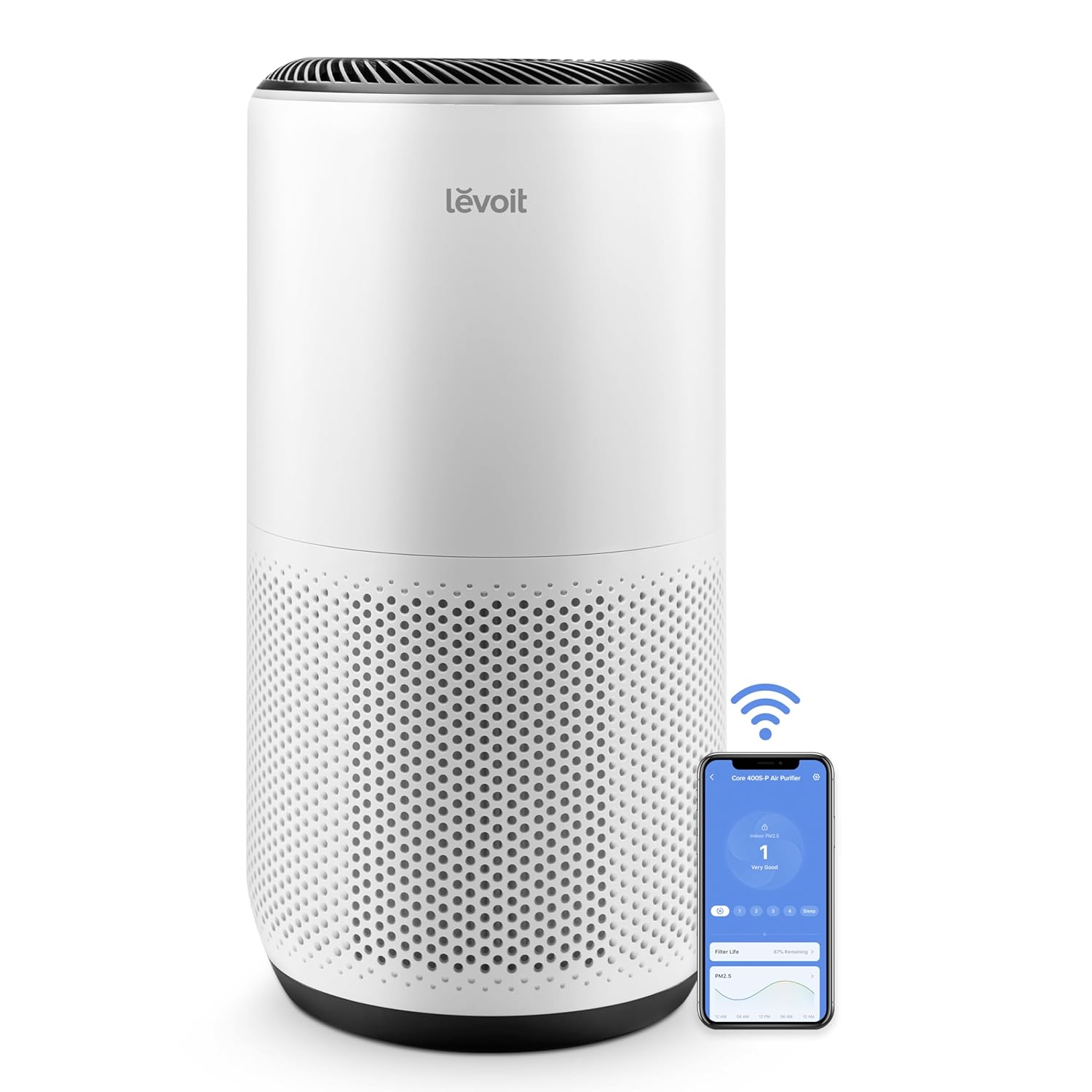
Modern purifiers often combine HEPA, activated carbon, and sometimes UV-C in a single unit. Many include air quality sensors, Wi-Fi connectivity, and app-based controls.
Best for: Users who want automated operation and remote monitoring.
Limitations: Smart features add cost. Sensor accuracy varies between models.
---
What to Look For When Buying
1. Filtration Efficiency (CADR and ACH)
CADR is the most important performance metric. Look for AHAM-verified CADR numbers, as unverified manufacturer claims may be inflated.
To calculate the ACH for your room:
```
ACH = (CADR × 60) ÷ Room Volume (ft³)
```
For allergy relief, aim for at least 5 ACH. For asthma or heavy pollution, 8 ACH or higher is preferable.
2. Coverage Area and Room Size
Manufacturers list a maximum recommended room size. In practice, performance drops as you approach the upper limit of that range. For open-plan spaces, consider multiple units or a higher-CADR model.
3. Noise Level
For bedroom use, look for units that operate at or below 35 dB(A) on their lowest setting. For living areas, up to 50 dB(A) on medium speed is generally acceptable.
4. Maintenance Costs
Filter replacement is the primary ongoing cost. HEPA filters typically cost $40-150 and last 6-12 months depending on usage and air quality. Carbon filters may need more frequent replacement in high-pollution environments.
Calculate annual operating cost:
```
Annual Cost = (Electricity per year) + (Filter replacements per year × Filter price)
```
5. Certifications to Look For
- AHAM Verified: Indicates CADR testing by an independent laboratory
- Energy Star: Indicates energy efficiency
- CARB Compliant: Required for sale in California; indicates ozone emissions meet safety standards
- UL Listed: Indicates electrical safety testing
6. Features That Matter
- Multiple fan speeds: Allows balancing noise and performance
- Filter replacement indicator: Helps you know when to change filters
- Auto mode: Adjusts fan speed based on air quality sensor readings
- Timer: Allows scheduling operation times
- Carry handle: Useful for moving the unit between rooms
7. Features That Are Less Important
- "Medical-grade" marketing: No independent body certifies consumer air purifiers as "medical-grade"
- "All-season" claims: All air purifiers work year-round
- Excessive smart features: Basic timer and auto mode are sufficient for most users
---
Common Mistakes to Avoid
1.
Buying too small for your room. An undersized purifier will run at maximum speed constantly, creating noise without effectively cleaning the air.
2.
Ignoring filter replacement costs. A cheap purifier with expensive filters may cost more over time than a more expensive unit with affordable filters.
3.
Placing the unit in a corner. Air purifiers work best when placed in an open area with good airflow, at least 6 inches from walls.
4.
Running only when you are home. For best results, run your purifier continuously on a low setting, increasing speed when air quality is poor.
5.
Expecting an air purifier to solve all air quality problems. Air purifiers help with particles and some gases, but they do not replace proper ventilation, source control, or HVAC filtration.
---
Setup and Installation Guide
Placement
- Place the unit in the room where you spend the most time
- Keep at least 6 inches of clearance on all sides
- Avoid placing behind furniture or in corners
- For bedrooms, place near the head of the bed but not directly next to it
- For living areas, place in a central location with good airflow
Initial Setup
1. Remove all packaging materials from the unit
2. Check that filters are properly installed (some units ship with filters wrapped in plastic)
3. Plug into a grounded outlet
4. Run on high speed for the first hour to quickly clean the room air
5. Switch to auto mode or your preferred speed setting
Maintenance Schedule
| Task | Frequency |
|------|-----------|
| Clean pre-filter | Every 2-4 weeks |
| Replace HEPA filter | Every 6-12 months (per manufacturer guidelines) |
| Replace carbon filter | Every 3-6 months (or as needed) |
| Clean ionizer plates (if applicable) | Every 2-4 weeks |
| Wipe exterior | As needed |
---
Frequently Asked Questions
Q: Do air purifiers help with allergies?
A: Yes. HEPA air purifiers are effective at removing common allergens including pollen, pet dander, dust mites, and mold spores from the air. For best results, run the purifier continuously in the room where you spend the most time.
Q: Can air purifiers remove viruses from the air?
A: HEPA filters can capture virus-containing particles. Some units also include UV-C lamps that can inactivate microorganisms. However, air purifiers should be used as one part of a comprehensive approach to indoor air quality, not as a sole solution.
Q: How often should I run my air purifier?
A: For best results, run your air purifier continuously on a low or auto setting. If you prefer to run it only when home, use the highest setting when you are present to compensate.
Q: Where should I place my air purifier?
A: Place it in the room where you spend the most time, with at least 6 inches of clearance from walls and furniture. For bedrooms, near the head of the bed is ideal. For living areas, a central location works best.
Q: How do I know when to replace the filter?
A: Most modern units have a filter replacement indicator light. Without an indicator, follow the manufacturer's recommended replacement schedule (typically 6-12 months for HEPA filters, 3-6 months for carbon filters). If you notice reduced airflow or increased noise, the filter may need replacement.
Q: Are ionizers safe?
A: Ionizers that comply with CARB and EPA standards produce ozone at levels below 0.05 ppm, which is considered safe. If you are sensitive to ozone, choose a HEPA-only purifier without an ionizer function.
Q: Can one air purifier cover my whole house?
A: Generally no. Most portable air purifiers are designed for single-room use. For whole-home coverage, consider multiple units or a whole-house HVAC filtration system.